

FROM RAGDOLL TO CHERUBIM
INTRODUCTION
(Click on BLUE links to bring you to sources)
Every great hall of recognition tells a story about who belongs inside it. More importantly, it tells an even louder story about who does not. Imagine a grand hall built to honor the founders of a civilization. The original architects designed it with three entrances—each representing a different path by which the civilization came into being. All three doors were used. All three were recorded in the earliest plans. All three bore weight.
Many years later, new custodians took control of the hall and sealed two of the doors. Not because they were unsound, but because they complicated the story the custodians wished to preserve. Visitors were assured those doors had never truly existed. Old records were dismissed, memories questioned, and alternative histories minimized. Yet foundations remember. Records survive. And biology, unlike politics, does not alter inheritance to fit consensus.
This is not an argument about preference or a plea for acceptance. It is an examination of the historical and genetic foundation of the Ragdoll breed. Long before championship halls recognized only the pointed Ragdoll, Ann Baker bred, recorded, and relied upon cats expressing mink, solid, and sepia coloration. These cats were not later deviations from the breed; they were part of its foundation. Modern genetic science, surviving pedigrees, and preserved breeding records collectively demonstrate that multiple color expressions existed from the breed’s inception and continued through carefully maintained lines.
What follows is the story of how portions of that history were narrowed, how foundational lines endured despite exclusion, and how the modern Cherubim designation emerged as a formal recognition of genetic traits that had always existed within the breed’s history.
ORIGIN OF THE BREED
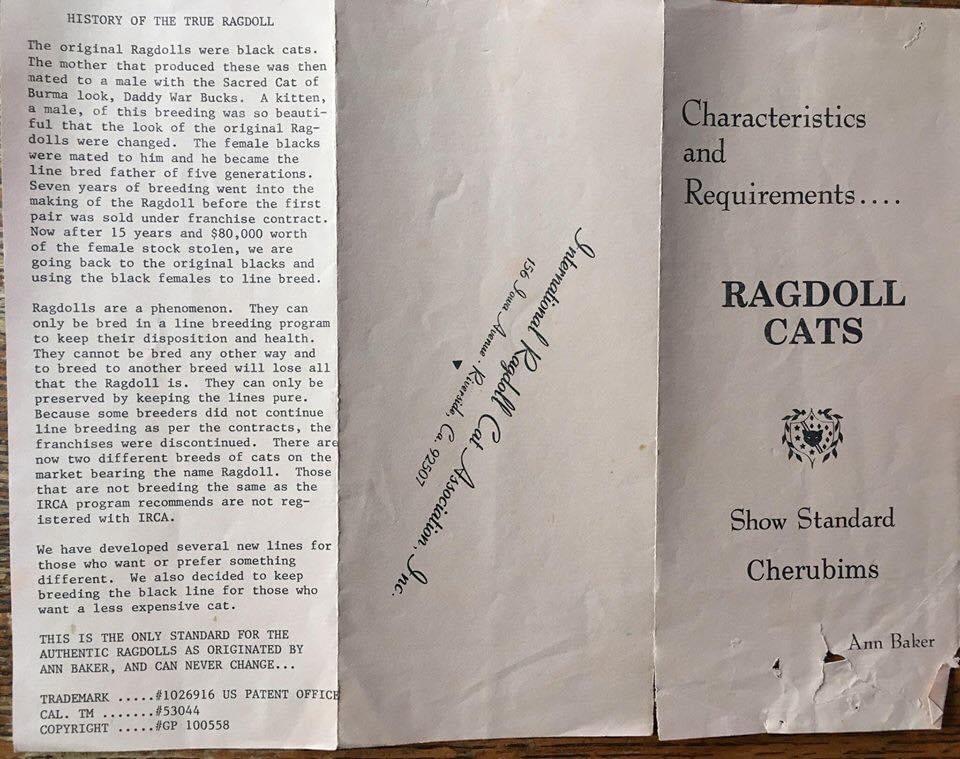
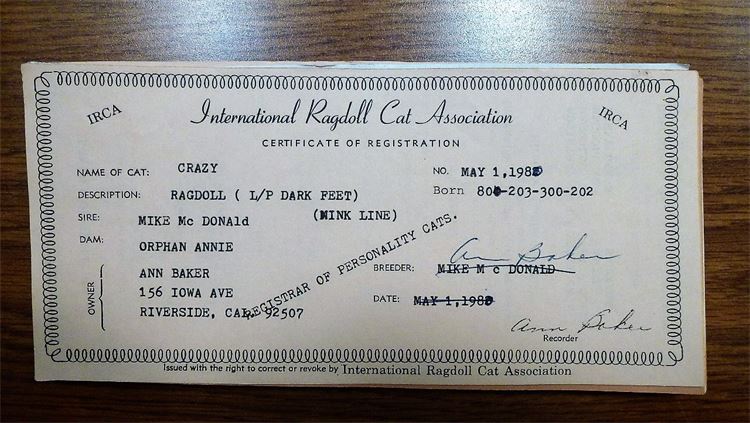
Ann Baker, creator of the Ragdoll breed, established the International Ragdoll Cat Association (IRCA), created her own breed standards, and developed a structured breeding and franchise system protected through contracts, trademarks, and patents. Her breeding philosophy incorporated a broad understanding of feline genetics, temperament, and type.
According to records preserved by The Association of the Original Ragdoll (VdOR), the breed originated from three ancestral cats of unknown parentage:
Josephine, a solid white cat carrying the pointed gene and founder of the “Light Line”
Burmese (Blackie), a mink cat carrying the pointed gene and founder of the “Dark Line”
Birman (Beauty), a cat resembling the Sacred Birman and carrying white spotting genetics and either the pointed gene or the burmese gene.
From these three ancestral cats emerged the five recognized foundation Ragdolls:
Raggedy Ann Daddy Warbucks — seal mitted
Raggedy Ann Gueber — seal mitted
Raggedy Ann Fugianna — seal bicolor
Raggedy Ann Kyoto — seal mitted
Raggedy Ann Tiki — seal colorpoint
Baker intentionally developed both a “Light Line” and “Dark Line,” balancing type and temperament through selective breeding. The Dark Line, developed through Burmese (Blackie), preserved mink-associated genetics from the earliest generations. Genetic analysis suggests that some cats phenotypically registered as pointed may genetically have been mink, particularly chocolate and lilac minks, which are born extremely pale and often resemble traditional pointed cats.
Baker continued preserving these genetics through cooperative catteries including Blue Mountain, Purple Heather, Vistin, JD’s, Rway, and Monty. Many cats from these programs later appeared in pedigrees with incomplete or “unknown” ancestry because of registration inconsistencies between IRCA and later registries.
GENETIC FOUNDATION
The genetics underlying pointed, mink, sepia, and solid coloration are located on the C locus, which controls temperature-sensitive pigmentation.
Pointed cats possess two copies of the recessive cs allele (cscs)
Mink cats possess one Burmese allele and one pointed allele (cbcs)
Sepia cats possess two Burmese alleles (cbcb)
Solid cats possess at least one full-color allele and one pointed allele or one Burmese allele (CC, Ccs, or Ccb)
The pointed mutation affects tyrosinase (TYR), producing the temperature-sensitive coat pattern characteristic of pointed Ragdolls. Pointed kittens are born white because the womb remains uniformly warm; cooler extremities darken as the kitten matures.
Genetic pairings demonstrate how naturally these traits coexist within breeding populations:
Solid × Mink = 25% pointed offspring
Mink × Mink = 25% pointed offspring
Pointed × Mink = 50% pointed offspring
Solid × Pointed = 50% pointed offspring
Pointed × Pointed = 100% pointed offspring
These combinations demonstrate that mink, sepia, solid, and pointed expressions are genetically interconnected rather than separate or unrelated populations.
DEVELOPMENT OF THE MODERN RAGDOLL
During the 1970s and 1980s, Denny and Laura Dayton worked to establish the pointed Ragdoll in major cat associations and show halls. According to Rovena Parmley, who worked closely with Ann Baker, Baker originally utilized all three types of coloration (pointed, mink, and solid) in her breeding program, although early show standards emphasized only certain pointed expressions.
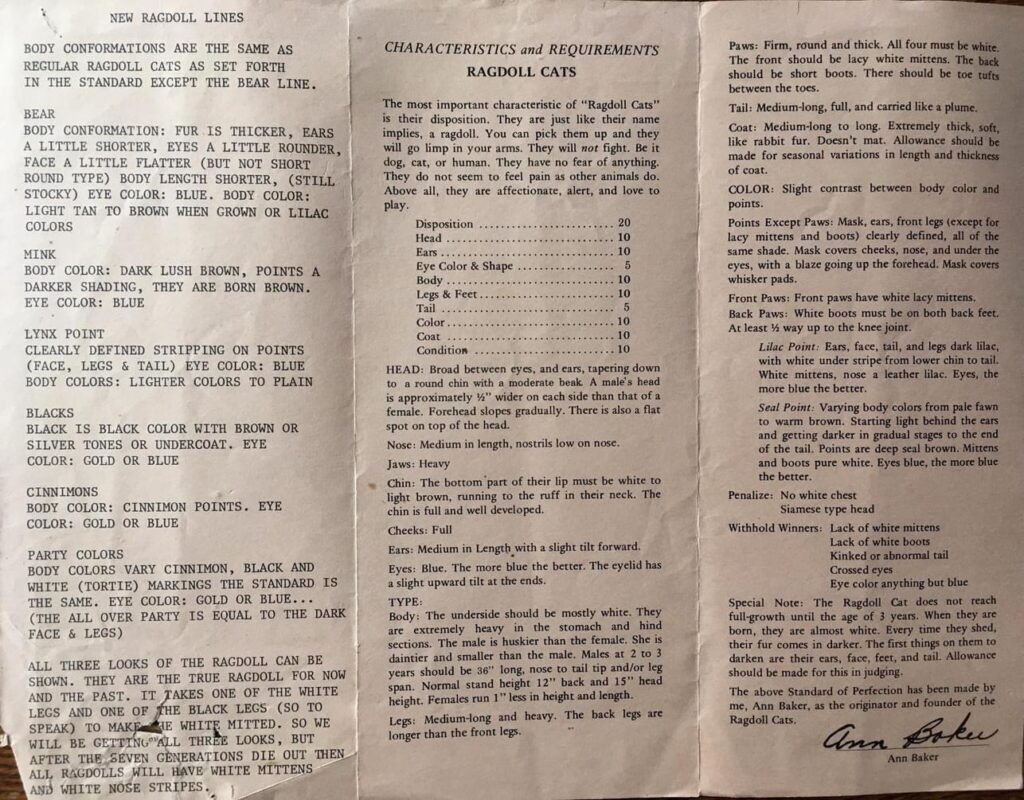
As the breed gained recognition, the Dayton group focused on standardizing the pointed Ragdoll for championship acceptance. Meanwhile, breeders remaining loyal to Baker and IRCA continued maintaining broader genetic diversity, including mink, solid, sepia, red, lynx, and other traits within their breeding programs.
Over time, many mink and solid Ragdolls were either registered phenotypically as pointed or omitted from official recognition despite being fully traceable to original foundation lines. Before modern DNA testing became available, blue-eyed chocolate and lilac mink cats were frequently indistinguishable from pointed cats based solely on appearance.
Examples such as Enchantacats Austin of ElviasRDBabz later demonstrated through DNA testing that genetically mink cats had existed within pedigrees long assumed to be exclusively pointed. These lines remain fully traceable to the original ancestral and foundation Ragdolls without evidence of later outcrossing.
Efforts by preservationists, including Tina Rollins and VdOR, sought to correct pedigree records and preserve documentation of these foundational lines. Their work emphasized that mink, solid, and sepia Ragdolls were not later additions, but enduring expressions present since the breed’s origin, as there was a “Sideline” to Denny Dayton’s Genetic Card.
FROM NEW TRAITS TO CHERUBIM
Mink, sepia, and solid Ragdolls had been registered within TICA since 1979 under the “New Traits” category, though they remained excluded from Championship competition.
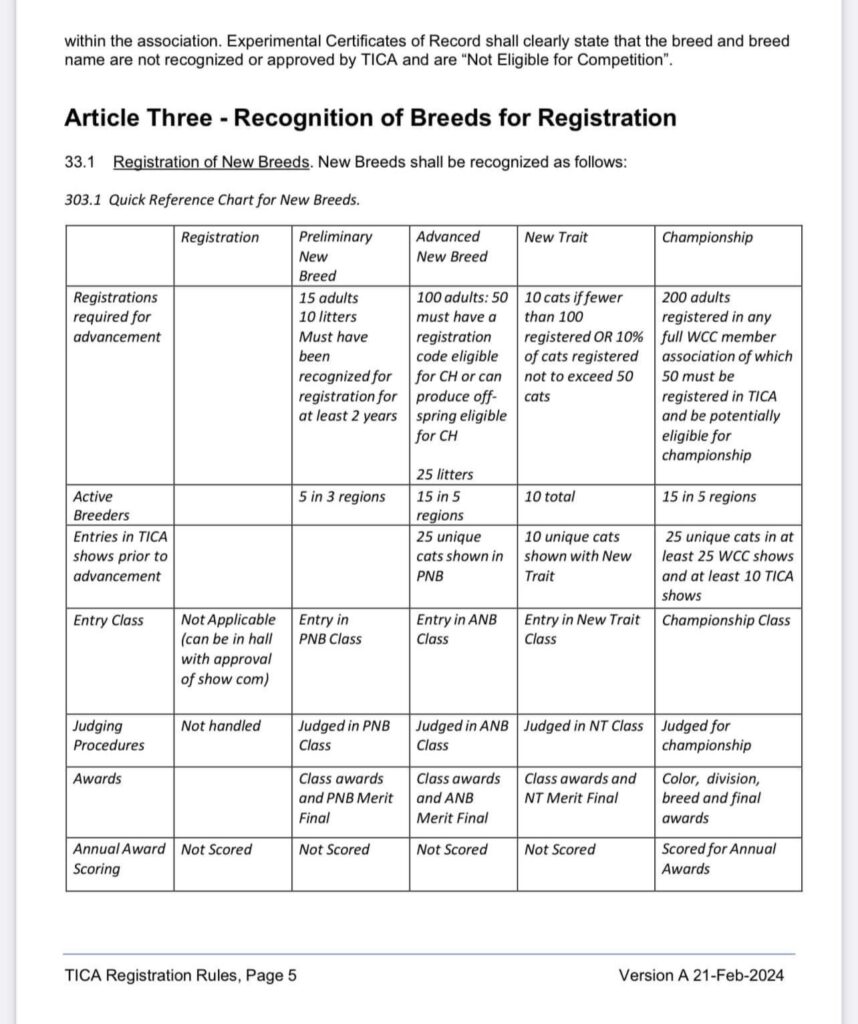
Beginning in 2022, proposals were introduced within both LCWW and TICA to formally recognize these cats within a broader breed structure. On October 17, 2023, TICA published a Notice of Intent initiating the advancement process for mink, sepia, and solid Ragdolls through the creation of a new breed group.
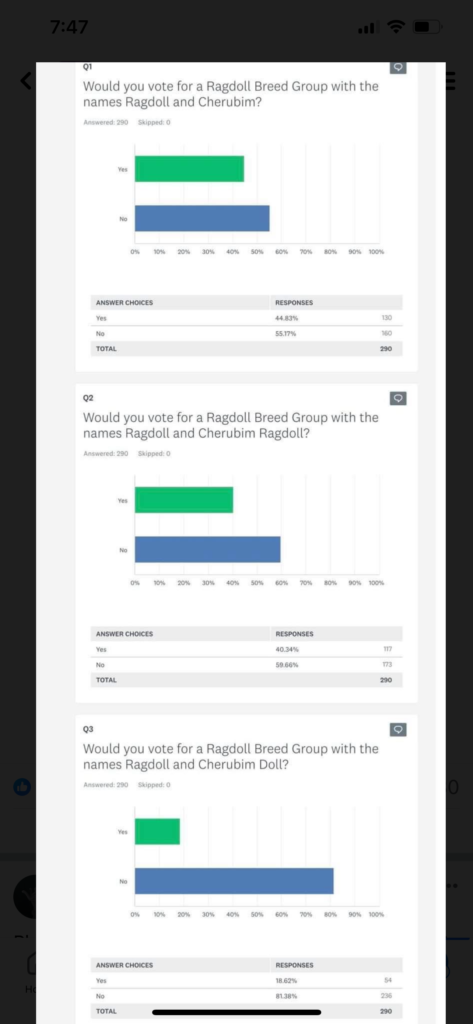
An unofficial survey circulated among breeders considered several names, including Cherubim, Cherubim Ragdoll, and Cherubim Doll. The final proposal, completed by Christine Lupo, Amanda Jimmink, and Elizabeth Boatwright, underwent multiple revisions with collaboration from breeders representing both pointed Ragdolls and emerging Cherubim lines.
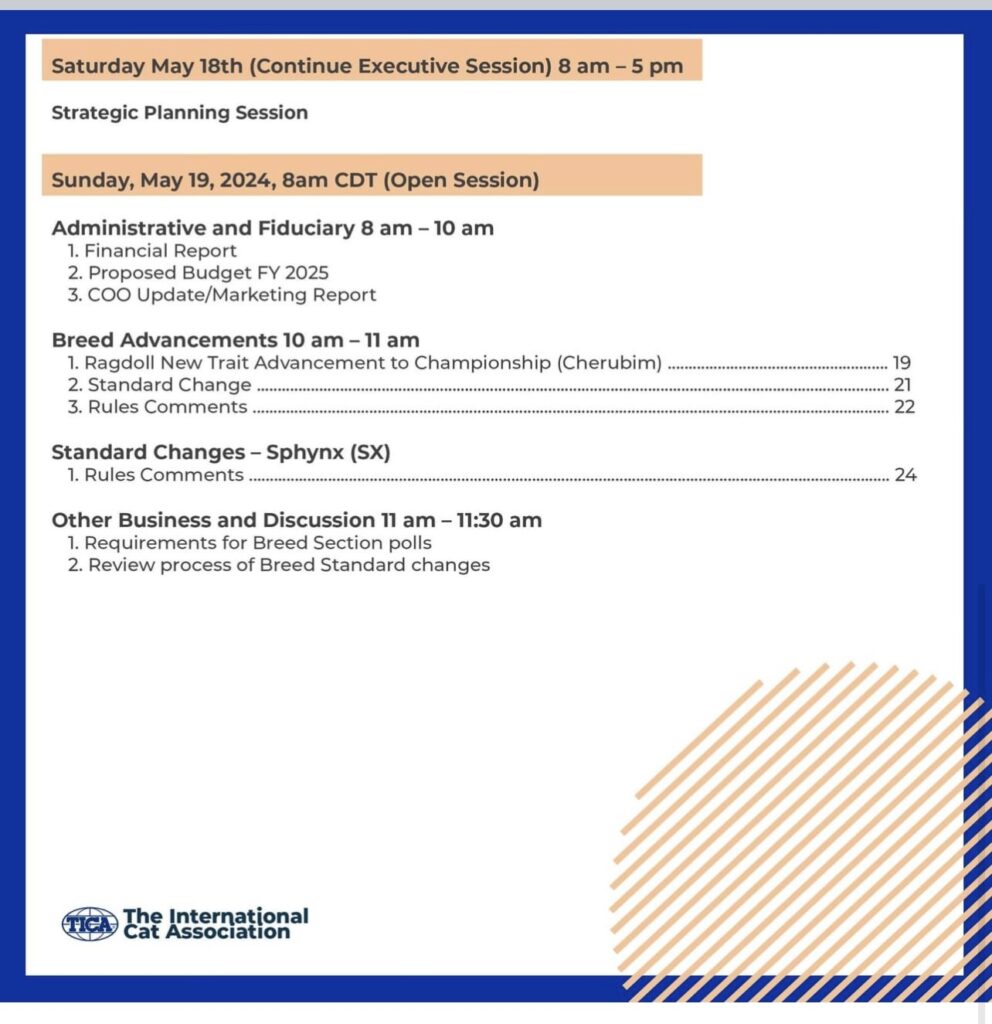
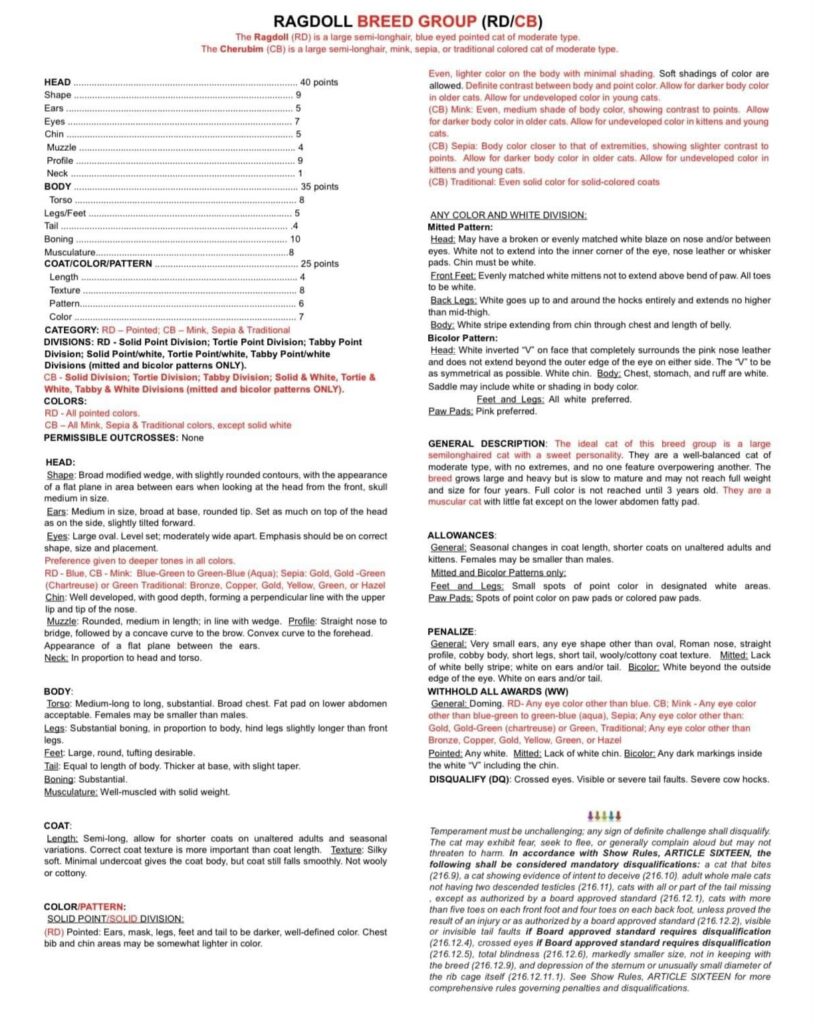
On May 19, 2024, the TICA Board of Directors unanimously approved the advancement of these New Traits into Championship status under the new Cherubim designation, creating the Ragdoll/Cherubim Breed Group. Beginning May 1, 2025, solid, mink, and sepia cats became eligible for Championship competition as Cherubim.
Subsequent milestones included:
Oakcrest Thor’s Legacy becoming the first Cherubim Supreme Grand Champion in TICA on February 26, 2026
Acaramia Rocky Road of Castle Reign becoming the first solid Cherubim Supreme Grand Champion on March 1, 2026
LCWW similarly expanded recognition, ultimately allowing mink, sepia, and solid Cherubim Ragdolls to compete in Championship classes by 2025.
The transition in TICA, however, introduced debate surrounding pedigree classifications, retroactive registration changes, and the preservation of historical records. Concerns emerged among breeders regarding automatic reclassification of previously registered Ragdolls into the Cherubim designation without owner consent. Discussions continue regarding how best to balance historical pedigree integrity, genetic transparency, and breed group organization.
RESOLUTION
The doors were never gone—only closed, questioned, and gradually forgotten. Yet the historical record persisted in pedigrees, breeder documentation, preserved bloodlines, and the consistency of genetic inheritance itself.
The emergence of Cherubim does not alter the foundation of the Ragdoll breed; rather, it acknowledges the broader genetic reality present since the beginning. mink, sepia, solid, and pointed expressions were all woven into the earliest generations of the breed and preserved through decades of dedicated breeding programs.
As those once-sealed doors reopen, the history of the breed becomes not diminished, but more complete. The hall remains intact, strengthened by a fuller understanding of its origins and by recognition of the breeders and preservationists who ensured that its foundational lines would not disappear.
TIMELINE
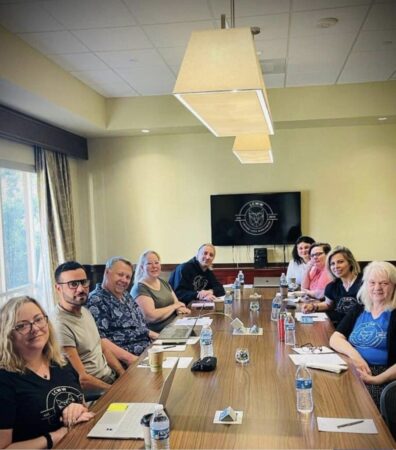
On June 2, 2022, a proposal was submitted to Steven Meserve, the owner and founder of LCWW (Loving Cats Worldwide), and discussions ensued pertaining to the addition of Mink and Sepia Ragdolls into the Championship Class with the Solids in the Non Championship Class. On October 20, 2023, the LCWW’s Feline and Friendship Advisory Panel passed the motion to have Ragdolls and Cherubim (Mink and Sepia Ragdolls) compete in the same breed class; in addition to this, LCWW also declared that Cherubim registration papers would also be changed to “Cherubim Ragdoll”! NYDIVINEDOLLS Mink Cherubim Ragdolls have earned LCWW titles of Junior Champion through Double Grand Champion as of May 4, 2024. On November 28, 2023, a proposal was submitted to request that Solid Ragdolls be considered for entry into the Championship Class of LCWW. As of January of 2025, LCWW has accepted all Mink, Sepia, and Solid (Traditional) Cherubim in the Championship Class (See LCWW Ragdoll & Cherubim Ragdoll Breed Standard below)!
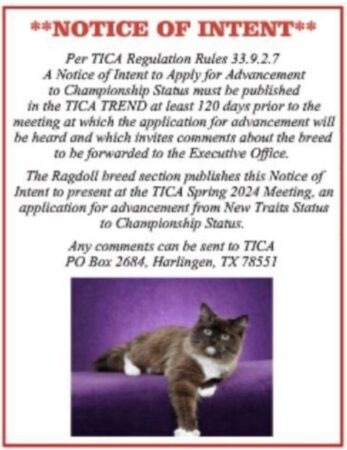
NYDIVINEDOLLS’ Mink, Sepia, and Solid Ragdolls have been shown in TICA within the “New Traits” class since August of 2010. On October 17th, 2023, the notice of intent was published in the TICA (The International Cat Association) Trend magazine as the first step taken to apply for “New Traits” (Minks, Solid, Sepia Ragdolls) to advance to Championship status as Cherubim through the creation of a breed group. The three years prior, finally, had enough “NT” cats showing to move forward with a proposal for advancement. This intent was submitted as per TICA rules which required it to be published a minimum of 120 days prior to the Board of Directors meeting at which time the application would be heard.
On November 5, 2023 an “unofficial” survey was sent to the breed section to permit all voices to be heard in regard to the name of the breed group. The choices were as follows: Cherubim, Cherubim Ragdoll, or Cherubim Doll. On November 6, 2023, the proposal was completed by Christine Lupo, Amanda Jimmink, and Elizabeth Boatwright with the breed group name still to be determined. Breeders of pointed, solid, mink, and sepia Ragdolls (there were five Blue Eyed Pointed breeders and five breeders representing the soon to be Cherubim) that collaborated on revising and finalizing the proposal that went through dozens of revisions, among ourselves, whittling it down from six pages to one. Upon determining the name and ability to pass an official vote, the proposal and application was completed and signed by all ten and submitted to the appropriate committees.
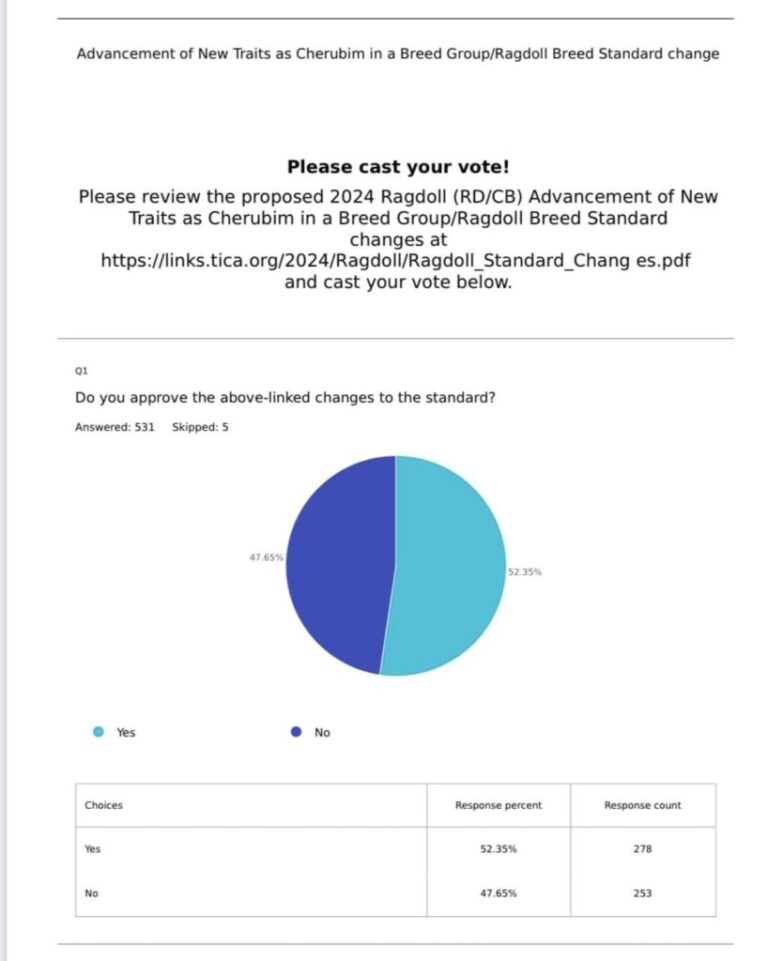
On February 26, 2024, the Rules and Genetics Committees provided their input and suggested changes for the proposal, of which was completed post haste. On April 21, 2024, the official New Traits Advancement Poll closed. The TICA Ragdoll breed section voted FOR the breed group of Cherubim (CB) to be incorporated into the Ragdoll Breed Standard and on May 1, 2024 it was determined that 52.35% voting members supported the intitiative. On May 19, 2024, the TICA Board of Directors voted UNANIMOUSLY to pass the Advancement of New Traits as a Ragdoll and Cherubim Breed Group. Cherubim will be required to complete the new breed annual reports for three years. Solid, Mink, and Sepia Ragdolls will be eligible to compete for CHAMPIONSHIP in TICA as Cherubim beginning May 1, 2025!
.
LCWW Breed Standard:
Click on the PDF icon to view the new Breed Standard
(Opens new window, close to return)

TICA Breed Standard as of May 1, 2025:
I posted the following on social media on July 25, 2025, as a RD/CB Breed Group Seminar still had not been posted on the TICA Cherubim page on their website:
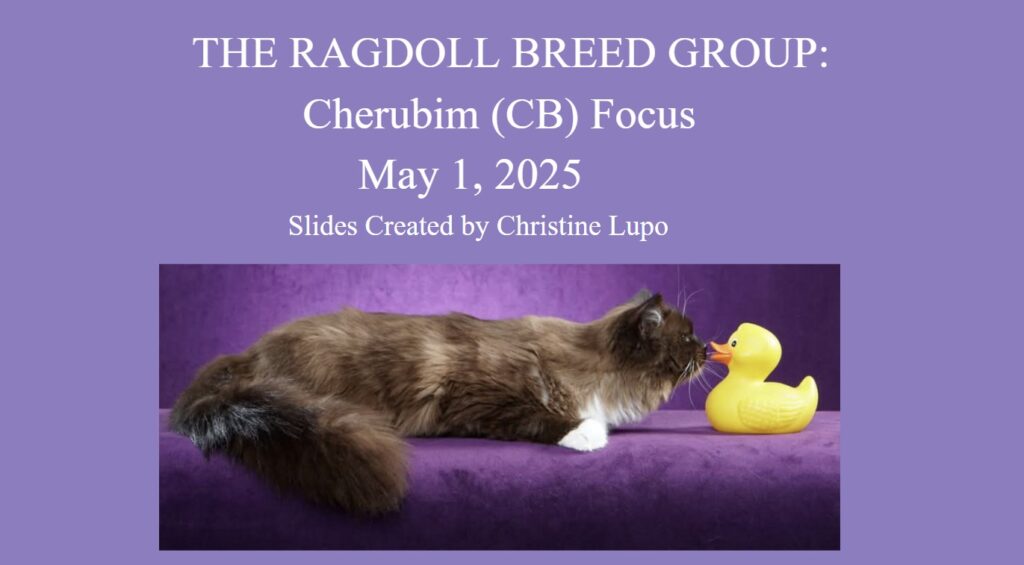
In May of 2024, the TICA Board of Directors voted unanimously to pass the proposal for the Advancement of New Traits as a Ragdoll Breed Group with the new name of “Cherubim” to encompass the mink, solid, and sepia Ragdolls. A new breed seminar (slide presentation) educating the public on the Ragdoll Breed Group should have been posted to the TICA Cherubim webpage before, or on, May 1, 2025 — the day the Cherubim breed was “born” and to be accepted for registration and show.
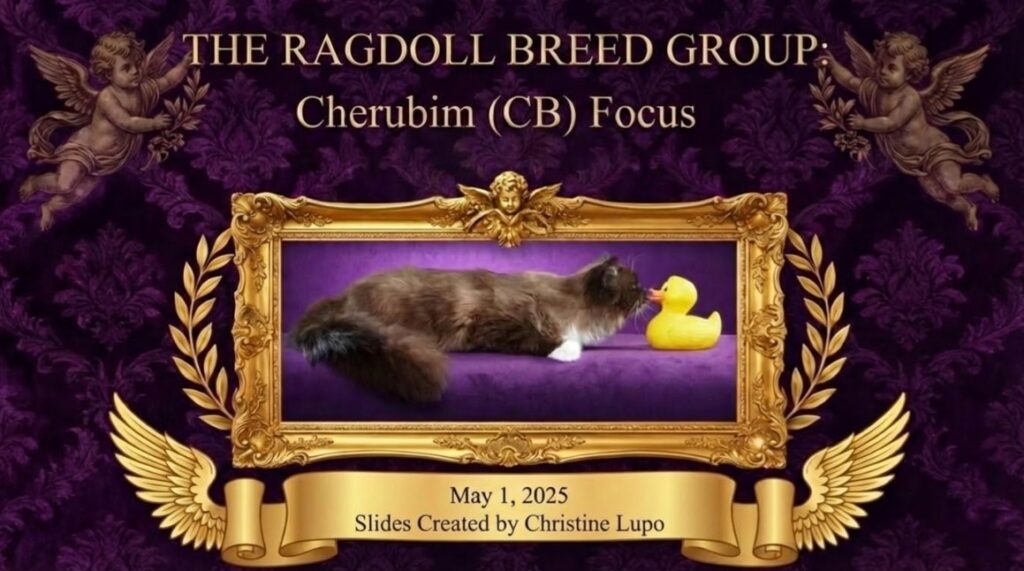
I submitted “The Ragdoll Breed Group: Cherubim Focus” (Google Slide Presentation) to the Ragdoll Breed Committee and gave the Chairperson permission to utilize it in its entirety, or any part thereof, as feedback and editing was suggested. In June of 2025, a condensed version of these slides was presented to judges, and trainees, at a TICA CEU Event in Sanford, Florida by TICA Judge Toni Jones and Judge Trainee Amanda Jimmink. It would be wonderful to have Alex Marinets, or any other Judges, speak about the cats on slides 25-33 in regard to type and meeting the breed standard, or what and how each might be improved through selective breeding. Every cat breeder should seek to constantly improve their lines. It is an ongoing process. The show hall is the perfect place to begin. Click to open, close to return:

On July 25, 2025, Amanda Jimmink wrote to the TICA President, Vicki Jo Harrison about addressing Cherubim registration changes. In that email she delineated concerns that have arisen regarding the automatic reclassification of all Mink, Sepia, and Solid Ragdolls to the newly recognized Cherubim breed, especially since the original proposal, narrowly approved by the breed section, was based on the understanding that such changes would occur only at the owner’s request for cats registered before May 1, 2025. Many breeders now feel misled, believing the outcome of the vote may have been different with accurate information. The sudden and retroactive changes have disrupted pedigrees—affecting accuracy, awards, and historical integrity—and have caused confusion around merit titles that no longer align with breed status. Additionally, inconsistencies remain in registration systems that still allow certain cats to be registered as Ragdolls. The intent of the proposal was to create a new Cherubim breed and a Ragdoll/Cherubim breed group moving forward, not to retroactively alter records. With minimal communication from leadership and no prior notice of these sweeping changes, frustration is widespread among breeders and owners. Amanda Jimmink suggested an alternate compromise to allow individual case submissions for those wishing to revert to original breed classifications, especially to maintain stable and accurate pedigrees in TICA’s genetically focused registry, if it is not feasible to revert the Mink, Solid, and Sepia cats back to SBT/Ragdolls prior to the May 1st date. After careful consideration, given the current circumstances regarding the TFMS Database, if reverting to original breed registrations for Mink, Solid, and Sepia cats registered before 5/1/25 is not an option, the name “Ragdoll” should be attached to Cherubim, resulting in the name “Cherubim Ragdolls.” Click on PDF below to read the proposal in its entirety:

June 1, 2026
Dear Members of the Ragdoll/Cherubim Breed Group:
Hello! My name is Christine Lupo, owner of NY DIVINE DOLLS located on Long Island, and I am officially submitting my candidacy for the October 2026 TICA RD/CB Breed Committee election. For just about two decades, I have been dedicated to preserving the original genetics, temperaments, standards, history, and the future of these phenomenal cats. I was honored to co-author the RD/CB Breed Group Proposal alongside Amanda Jimmink and Elizabeth Boatwright while collaborating with breeders representing both pointed and non-pointed programs. As of May 1, 2025, through the combined efforts of many dedicated breeders and exhibitors, Cherubim became eligible for Championship competition and have already produced Champions through Supreme Grand Champions, demonstrating their quality and viability.
Beyond committee work and breed development efforts, I have continued public education regarding breed history, pedigrees, genetics, and standards while attending TICA shows, where I am usually easy to spot as the tall blonde surrounded by beautiful Ragdolls and Cherubim in purple sequined show shelters, teaser in my back pocket, and lint brushes nearby to battle the endless cloud of glitter that is cat hair!
As the Breed Group advances, important work and opportunities for continued growth lie ahead. One issue of concern that arose from the transition has been the automatic retroactive reclassification of mink, sepia, and solid Ragdolls, within the TFMS database, which affected the historical identification of some pedigrees. The protection of correct pedigrees and accurate breed history is crucial for breeders, owners, as well as posterity.
I believe it is important that pedigrees accurately reflect the identity under which cats were originally registered and exhibited prior to 5/1/25. During prior discussions regarding possible solutions, and amid heightened emotions, I supported the compromise name “Cherubim Ragdoll” only if restoration of those earlier records proved unfeasible. The Cherubim name is now an established part of a unified and familial RD/CB Breed Group; therefore, I am not seeking to change the name. My focus remains on preserving accurate historical records while supporting continued progress together as one breed group family. Potential solutions would be for the Breed Committee, in collaboration with the TFMS database administrators, to consider implementing a historical annotation (similar to the proposal to add DNA health data to pedigrees) or to initiate a dual-designation system within the registry.
Continued efforts to address and preserve historical pedigree records remain an important consideration and goal. Whether your program focuses on pointed Ragdolls, Cherubim, or both, I believe every breeder deserves accurate records, access to educational resources, and a voice in the future of our breed group.
If elected, I will continue focusing on:
• Historical pedigree preservation and accuracy
• Completion of the required Breed Group Breeding Program
• Updated breed education and seminars
• Genetic diversity, health testing, and responsible breeding practices
• Continued collaboration, respectful communication, and constructive progress.throughout the Breed Group
I would also like to stress the fact that my efforts remain focused solely with TICA and the responsible development of the Ragdoll/Cherubim Breed Group within this association.
With your support and your vote, I am eager to get to work on these initiatives for all members of this breed group family.
Warmest regards,
Christine Lupo
NY DIVINE DOLLS Ragdoll Cattery
TICA FELINE MANAGEMENT SYSTEM (TFMS Database) & The RD/CB Breed Group:
Should mink, solid, and sepia cats registered before May 1, 2025, be listed as Ragdolls on their pedigrees?
Mink, sepia, and solid Ragdolls that were registered and historically recorded as Ragdolls prior to May 1, 2025 were subsequently retroactively reclassified within TFMS following Cherubim recognition. Protecting the place of mink, sepia, and solid cats in pedigrees that were registered as Ragdoll before May 1, 2025 has value beyond simply retaining an old breed name. It preserves the historical chronology of the breed, genealogical continuity within pedigrees, and the origins of TICA’s own registration records. If someone were to research these pedigrees ten, twenty, or fifty years from now, that person could see “Cherubim” attached to ancestors born and registered many years before the Cherubim designation existed and could possibly and reasonably conclude that Ragdolls and Cherubim represented two separately identified historical populations at that time. That would not accurately reflect how those cats were actually registered or how these bloodlines developed. A current classification should govern the cat going forward; it should not rewrite the historical designation under which the cat was originally and actually registered in TICA. Denny Dayton maintained a “Sideline” to his genetic card that acknowledged Ann Baker’s IRCA lines that he was able to verify himself. He understood the importance of provenance, of preserving where those lines originated, and how they related to the development of the Ragdoll. The RD/CB Breed Committee must be custodians of the breed and strive to accomplish the preservation of TICA’s historical registration data while retaining the Cherubim as the current competitive classification. Should TICA’s database preserve an accurate record of what these cats were registered as at the time? That answer should be a resounding, YES! Preserving the historical integrity of a genetic pedigree database, that will endure long beyond the issues we are addressing today, must be a priority not only for the RD/CB Breed Group but for TICA as well.
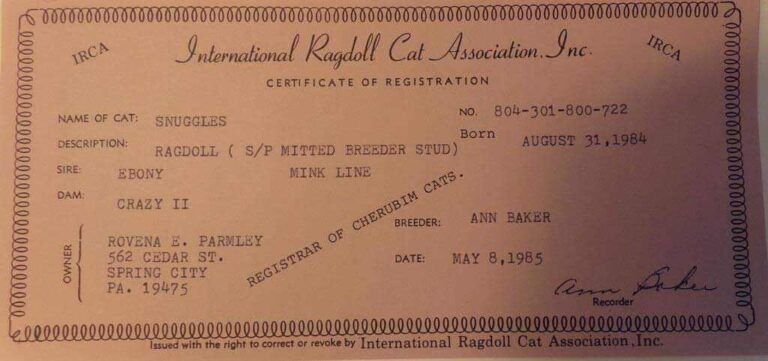
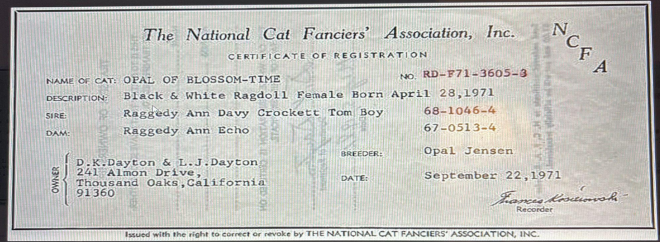
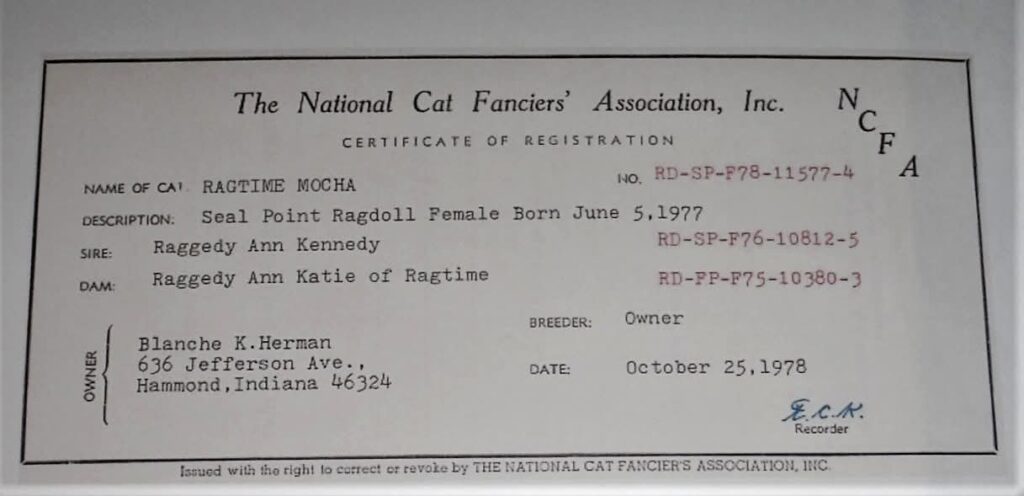
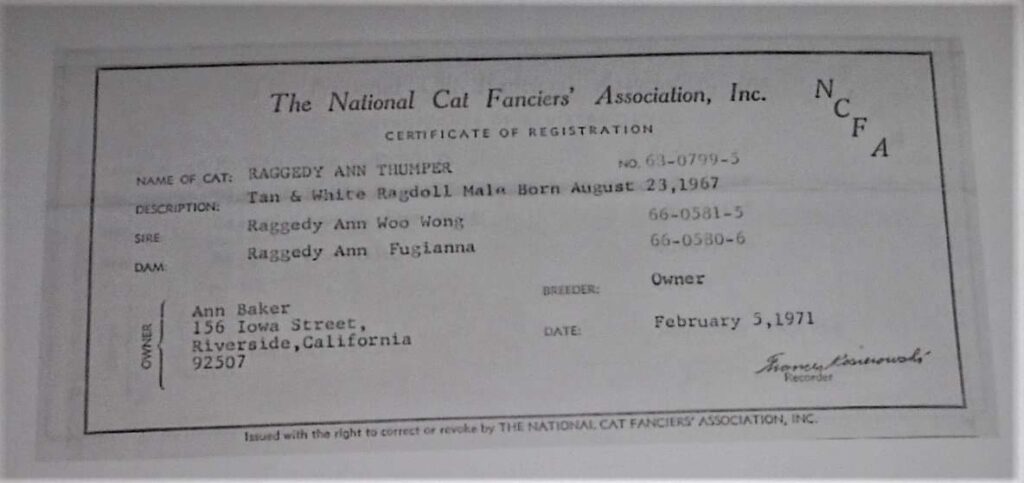
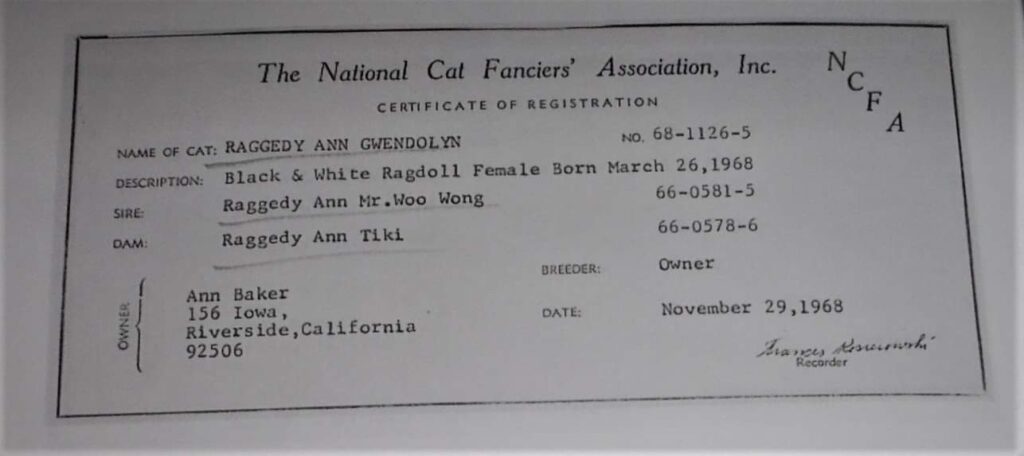
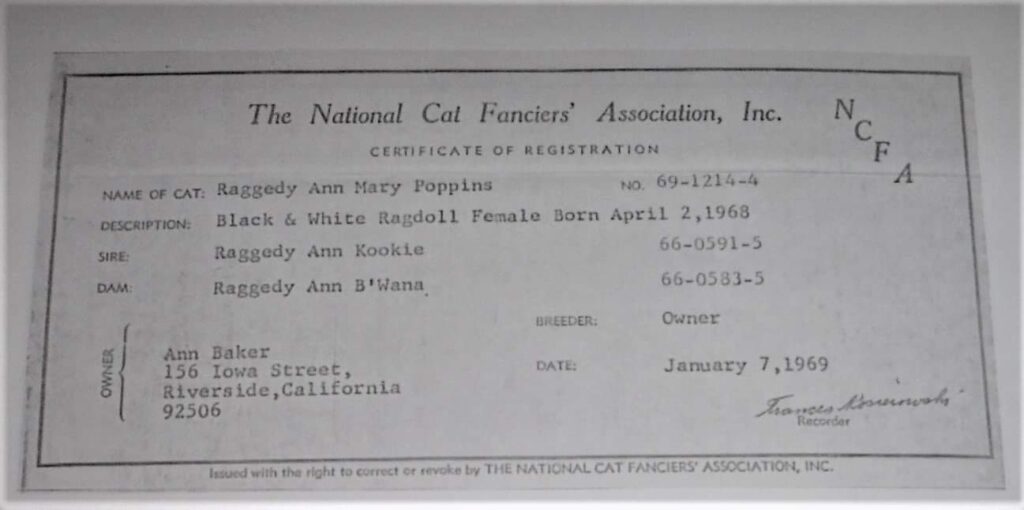
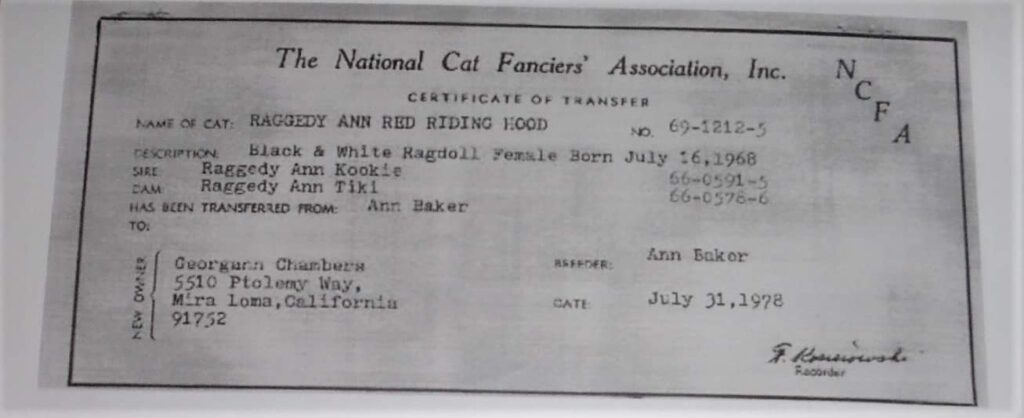
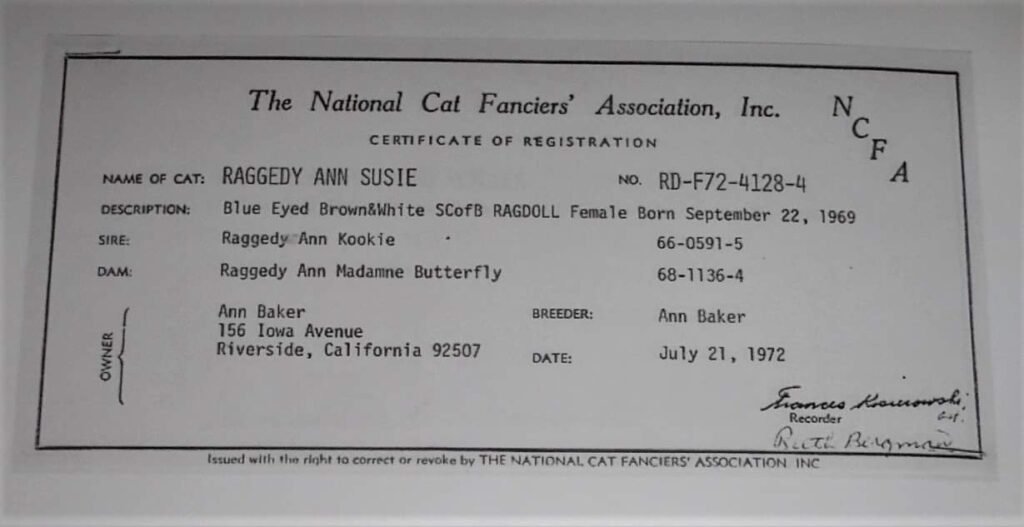
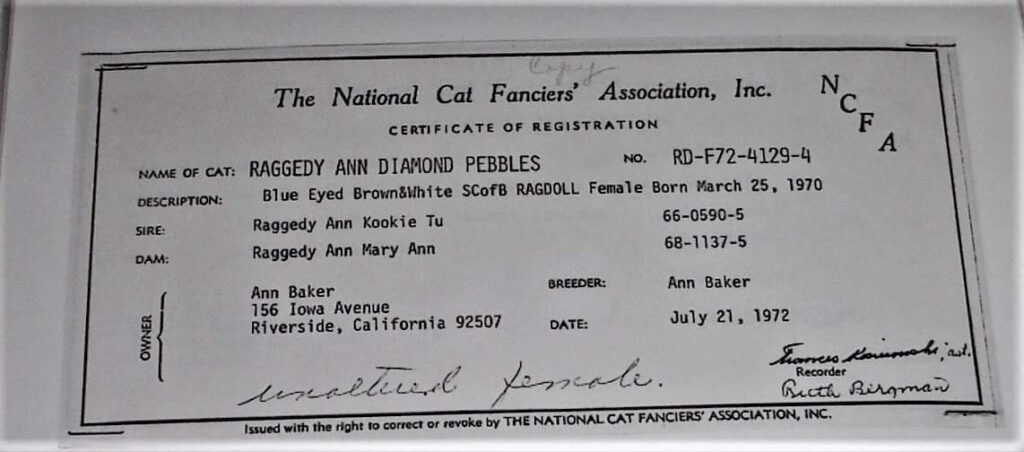
The Ragdoll Registrations below are Solid and Mink cats:
***Click here for more of Ann Baker’s early Solid, Mink, and Lynx lines.